The 1st Installment
WORK — The Meaning of Productivity
Held on September 18, 2026
We are promised a life of frictionless existence,
By creators of infinite amusement. A life without
The definition of reality that's felt against our wills:
Degrees of pain. To feel is to know by contact with the outside.
To find work is to define a responsibility for a portion of a life.
The same companies that finance data centers at a cost of $27,000,000,000.00 for 6 square miles are advertising their new software is altering a majority of professions. Yes, some professions will disappear because a software tool (a.k.a. Large Language Models, a.k.a. LLMs, a.k.a. “Agents”, a.k.a. “An Angry Mob that has a 10% chance of ending Humanity by the end of the decade.”) has altered:
- The Approach
- The Existing Tools
- The Context
Of your profession.
The Approach
The way that was done, is no longer done. In the history of the United States, several periods of disruption from technology has caused the erasure of an entire type of employment or occupation. After the Reconstruction era, the United States experienced a period of rapid industrial expansion causing visible poverty and a real wage growth of 40% from 1860 to 1890. The change that happened was the activation of laborers from the fields into the factories. With the following innovation of electric light in the late 1890s, the activity became even more intensified. Throughout the and the automobile, horse populations declined
For many that want to find a purpose in life, it is through the Dignity of a stable career, saving enough to retire, and moving on to other aspects of their lives.
How are we to take this into account as quantity of dollars several times a lifetime of earnings are being thrown by?
The 2nd Installment
EDUCATION — Linguistic Skills in Schools
Held on October 9, 2026
The conversation for “Linguistic Skills in Schools” revolved around a few different topics. Education, Communication, Originality, Learning, and current news: bioweapons, cyberattacks, and guardrails.The group was small and lively with expert opinions from Higher Ed, the Music Industry, and the Film Industry.
There is a reckoning for higher education for evaluations of students on comprehension of the material for a professional degree. One homework assignment to a class of 30 people will tend to result in similar papers due not to comprehension but by asking a SLiME Tool to generate a sequence of text. A solution has been to change the metric proportioning to decrease the weight of assignments that can be done outside of the classroom. The abilities of students were made clear when a class's average score on homework would be 100% while their average text score coming in at 40%. By dropping the weight from 50-50 to 20-80 the courses incentivized studying for the in-classroom examination, which would be proctored for instructor-approved usages of artificial intelligence.
How we teach matters in results and self-description. Artificial intelligence software like large language models define the patterns of output with guardrails with “hidden rules”—Like how the open-weight models from China do not acknowledge the actions at Tiananmen Square in June 1989—to know these patterns exist and provide the models to our youth is a breach of duty to younger generations.What words is Google Gemini avoiding, or concepts that Claude is trained to guide us towards? If the source cannot be validated for authenticity, how may we trust the validity of advice or information given to us, especially to teach unsupervised?
The 3rd Installment
CREATIVITY — Procedural & Generative Production
October 23, 2026
Is Calculated-Creativity Creativity, or Discovery?
Creativity is a challenging topic to discuss in the light from the field of artificial intelligence because there are a.i. experts who extol “creativity” in IBM's DeepBlue beating Garry Kasparov (1963–) in 1997, or in Google DeepMind's AlphaGo against South Korean professional Go player Lee Sedol (1983–) in their 5 game series in 2016. I do not know if I will ever be able to adapt a definition that fulfills the concept of Creativity as I have come to enjoy it. But Frontier A.I. Labs defining creativity by these narrow examples is pigeon-holing the reality of how creativity is.
Creativity requires defining a new context, a new perspective. (Which some could argue as a requirement for AlphaGo and DeepBlue's success.) To speak geek, I would call “new perspective” as orthogonal to the plane of known-matters: it is doubtful that AlphaGo was trained on data outside of the Book of Go1 yet the software “found inspiration” by playing against itself over thirty-million times in order to find a move that did not exist in the Book of Go in Match 3. At that moment, which is fulfilling the meaning of novelty (i.e. "doing something that has never been done before,”), has Creativity or Discovery been achieved?
I find that analogue hard to reckon. It takes advantage of an un-informed audience marveling at a spectacle of “man vs machine.” Let's take Chess as a brief example: being around since the 13th Century, the game began a sport of competition in the late 19th Century. This was the convergence of a mature literary scene with economical travel means, allowing for publications of booklets containing notable games between notable players who could travel for matches. Major fodder for innovation occurred from the discovery of large overtures of strategies against players with unique strategies, now having the opportunity to play for the first time. (Ocean steamships, around since the second quarter of the century, were entering their first golden age in the late 19th Century, shorting trips from months to a week.) The “pages” of the Book of Chess were vast and unwritten, so any movement no matter its prominence would be considered “novel” in the eyes of a program like AlphaGo, but the typical fan of a game at say the West Village Marshall Chess Club of the 1920s wouldn't bat an eye because that novelty was an expected steps towards some larger development or oeuvre.
During Match 2 on March 10, 2016, announcers and devoted spectators called AlphaGo's 19th stone (game Move 37) “creative” and “unique” because it violated the fundamental rules practitioners follow: “you do not play a 'shoulder move' on the 5th line”. With a probability of play of 0.0001%2, this move cinched AlphaGo the win, with professional Go players describing the “series of mistakes as an intentional strategy in hindsight.” Demis Hassabis (1976–)3 was the chief manager of the team that programmed AlphaGo for this task and spent the following day fielding questions.
In chapter “One of Ten Thousand Things” of "The MANIAC"4 by Benjamín Labatut (1980–), Mr. Hassabis described the training process involving the Policy Network and the Value Network (names for use-cases of Bayesian Networks in large language models). The process's heuristic is to enhance the software's ability to win at Go: it's a refinement of the weights of networks through more than “thirty million games played against itself.” The combination of these two networks allow for AlphaGo to 1) reference “common sense” policies via Monte Carlo5 tree search; and 2) reference an archive of prior games; akin to a seasoned player being able to instantly reference prior-art games. That's recall, not creativity.
That process is a virtual training session to constructing a Virtual “Book of Go.” This “Virtual Book of Go” that is the Value Network is just a dictionary of games, games that have never been played except for in the RAM of the computer. We could argue metaphorically, like in the 19th Century, AlphaGo (in the span of a real day) voyaged to “AlphaGo-Land” and played against the typical player of that land to “practice and discover new moves and strategies” before returning to compete with Lee Sedol on Match 2 of the series, to win.
And yet, on March 13, Lee Sedol won Match 4 with his own “divine” Move 78, causing AlphaGo to spiral with mistake after mistake. All that Lee had between these matches for reference were brief conversations with other Professional Go players in his hotel room. When asked afterwards, Lee said,
"At that point in the game, it was the only move I could see. There was no other placement. It was the only option for me, so I put it there. I am quite humbled by all the praise I am getting for it.”During Match 4, AlphaGo raked its archives, searching over 95 moves ahead of Move 78 to find a viable path to victory, and continued to play until 180. After calculated its odds of winning at below 20%, it resigned.
Hassabis and his team had AlphaGo replay the match with AlphaGo playing as Lee Sedol to understand if AlphaGo would have played the move. It graded the probability of playing that move as 0.0001%, or 1 in 10,000 chance. The same probability of its own Move 37 in Match 2 that made the entire Go community recognize its potential.
AlphaGo could not function after Lee Sedol's Move 78 within Match 4. Because the weights were static, and maybe because there's no creativity when it's calculated.
1 When discussing games, the “Book of ___” refers of all games ever played. In Chess, a large part of mastery is memorizing the prior work to draw insight from. This supports the naming ritual of certain classic tactics or patterns (e.g. the Ruy Lopez opening).
2 Labatut, Benjamín. The MANIAC. Translated by Sophie Hughes. New York: Riverhead Books, 2023.
3 Demis Hassabis founded DeepMind in 2010 in the United Kingdom, which was acquired by Google in 2014. Mr. Hassabis served as CEO until 2026. He is now the Chief Scientist of Alphabet Inc. (parent company of Google), and Chairman of Google DeepMind.
4 "The MANIAC" is a fictionalized biography on the life of John von Neumann (1903–1957), the famous Hungarian scientist involved in many Mathematical innovations and the Manhattan Project.
5 Monte Carlo Tree Search is an algorithm for Game-State Tree Searching using the Monte Carlo Method. The Monte Carlo Method (circa 1946) was invented by Stanisław Ulam (1909–1984) (a contemporary of von Neumann whom also worked on the Manhattan Project).
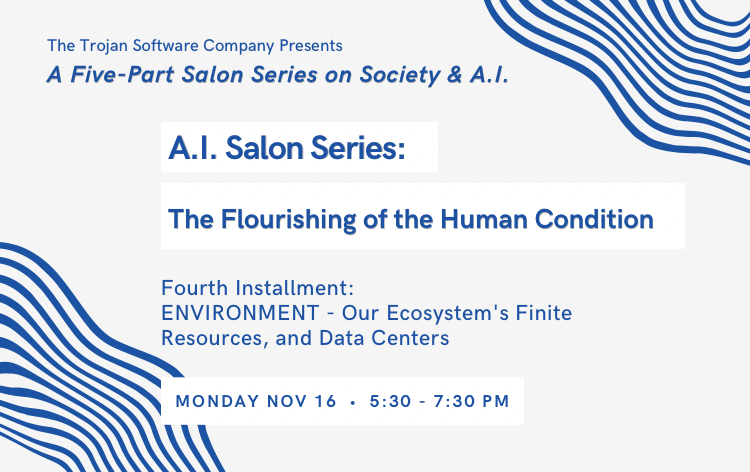
The 4th Installment
THE ENVIRONMENT — Our Ecosystem's Finite Resources, and Data Centers
November 16, 2026
Reference Documents
Last Updated: November 4, 2026Reference PDFs (by oldest original date published)
- 0370 BCE: The Phaedrus, by Plato, translated by David Horan (especially PDF Page 34 and on)
- 1843 AD: "Sketch of the Analytical Engine Invented by Charles Babbage" By General Luigi Federico, Officer of the Military Engineers; translated by Ada Countess of Lovelace Menabrea with additional works
- 1950 AD: "Computing Machinery and Intelligence" by Alan Turing
- 1958 AD: "The Perceptron: A Probabilistic Model for Information Storage and Organization in the Brain" by Frank Rosenblatt
- 1965 AD: "Speculations Concerning the First Ultraintelligent Machine" by J I Good (Link to Stanford Archive)
- 1967 AD: "The Death of The Author" by Roland Barthes
- 1967 AD: "All Watched Over By Machines of Loving Grace" by Richard Brautigan
- 1969 AD: "Language Counter Memory Practice: Selected Essays and Interviews—'What is an Author?'" by Michel Foucault (PDF Page 113)
- 1980 AD: "Minds, brains, and programs" by John Searle
- 2023 AD: "Attention is All You Need" by Google
- 2024 AD, June: "Situational Awareness" by Leopold Aschenbrenner
- 2024 AD, October: "Machines of Loving Grace" by Dario Amodei
- 2025 AD, June: "Project Vend: Can Claude run a small shop? (and why does that matter?)" by Anthropic
- 2026 AD, May: "Encyclical: Magnifica Humanitas" by Pope Leo XIV
- 2026 AD, June: "From AGI to ASI" by Google DeepMind
- 2026 AD, August: "Hugging Face Incident Report" by Redwood & METR
- 2026 AD, September 12: "We Must Pace the Frontier" by Dario Amodei
Welcome
All downloads are provided for educational and research purposes. Please respect the copyright of the authors of these works.